Monday, 24 February 2014

THE LITTLE FIVE
Elephant shrew

The cutest of the "Little 5", the elephant shrew is a small, insect eating mammal with a long nose. Elephant’s shrews are very common in Southern Africa but seldom seen. They can grow up to 30 cm and have relatively long legs which they use to hop about looking for food. Their little trunks are quite flexible and can be twisted to sniff out insects, which they then flick into their mouths using their tongues. They've been known to leap almost 3 feet in a single bound. Elephant’s shrews are not very social and often live in monogamous pairs. They mark their territory with a strong scent produced by a gland under the tail. Scientists have recently discovered the Elephant shrew may actually be more closely related to elephants than shrews.
The Buffalo weaver bird can either refer to the common Black Buffalo Weaver, or White-headed Buffalo Weaver. Both are found in dry areas and are very common especially in East Africa. Out of all the Weavers, the Buffalo weaver is a messy nest-maker. Their large communal nests have several side-entrances and are usually made of sticks and thorns. They are among the largest of the weaver birds, measuring up to 24 cm. Their diet consists of small and medium grass seed, small insects, and small fruits. They are quite loud and social these birds, with a range of cackles and calls.
 
Rhino Beetle
The Rhino beetle is a large insect with ferocious looking body armor. They belong to the scarab beetle family (Scarabaeidae). Rhino Beetles can grow up to 2.5 inches long. Both sexes have similar body armor, but only the males have a large horn (hence the name "rhino") which they use in combat with other males. Rhino beetles also use their horns to dig for food inside rotting tree trunks, or undergrowth. They actually have quite a varied diet; they'll eat rotting fruits, bark, sap and vegetable matter. Rhino beetles are among the strongest living creatures in the world in proportion to their body weight. Rhino beetle larvae can take up to five years to mature into an adult. They can be found throughout Africa.

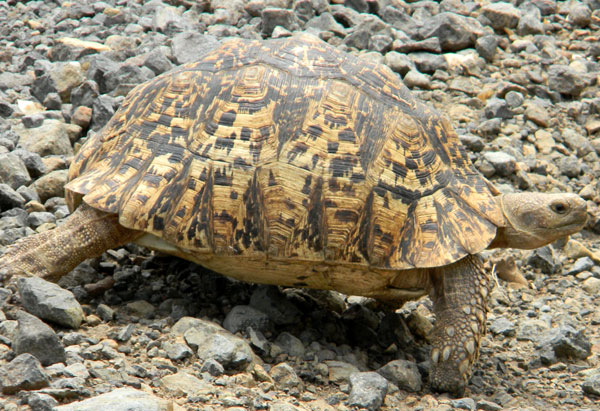
Leopard Tortoise
Leopard tortoises all have unique and beautiful markings on their shells, hence their name. They can be found throughout sub-Saharan Africa, mostly in the drier, grassy areas of the continent. Leopard tortoises generally eat grasses, and this must suit them well because they live up to 100 years. They generally do not burrow except when building a nest for their eggs. They are good diggers though, I used to try and keep them as pets when I was very young, and they always managed to escape. Leopard tortoises can reach up to 18 inches in length and weigh up to 40 lbs. They are solitary animals.
 
Antlion
I have spent hours as a young child in Malawi trying to catch antlion larvae. The antlion is the smallest member of the "Little 5" club, and in the US you may be more familiar with its name "doodlebug". The Antlion is the larvae stage of a winged insect that looks like a dragonfly. Antlions dig little conically shaped sand traps in the ground to catch small ants, which they eat by basically sucking them dry. They then toss out the dry carcass and wait for their next victim. Not surprising then, they tend to live in sandy, arid areas throughout Africa. The antlion larva has a wide body, large jaws and apparently lacks an anus. It is a bit of a mystery as to why they are called "antlions", maybe because of their predatory nature.
 
For tours in  Africa :http://sunriseafricasafaris.com/tours.php
 
Contact us for reservations::tours@sunriseafricasafaris.com

Follow us on Skype:sunriseafricasafaris

Our Blogpost:http://http://sunriseafricasafaris.blogspot.com/

Friday, 21 February 2014


 Cheetah
FACT FILE:
Swahili Name:     Duma
Scientific Name:     Acinonyx jubatus
Size:     30 inches at the shoulder
Weight:     110 to 140 pounds
Lifespan:     10 to 20 years
Habitat:     Open plains
Diet:     Smaller antelopes
Gestation:     90 to 95 days
Predators:     Eagles, humans, hyenas, lions

The lion is said to be majestic, the leopard ferocious and shrewd. But elegant and graceful best describes the cheetah. The cheetah is smaller than the other two cats, but by far the fastest at speeds of 70 miles per hour it can run faster than all other animals.
Now restricted to sub-Saharan Africa, wild cheetahs once were found in most of Africa, the plains of southern Asia, the Middle East and India.

Physical Characteristics
The cheetah is built for speed. It has long, slim, muscular legs, a small, rounded head set on a long neck, a flexible spine, a deep chest, nonretractable claws, special pads on its feet for traction and a long, tail for balance. Although fast, the cheetah cannot run at full speed for long distances (100 yards is about the limit) because it may overheat.
Cheetahs have distinctive black "tear stripes" that connect from the inside corner of each eye to the mouth that may serve as an antiglare device for daytime hunting.

Habitat
Cheetahs are found in open and partially open savannas.

Behavior
Cheetah mothers spend a long time teaching their young how to hunt small live antelopes are brought back to the cubs and released so they can chase and catch them. Unlike most other cats, the cheetah usually hunts during daylight, preferring early morning or early evening, but is also active on moonlit nights.
Cheetahs do not roar like lions, but they purr, hiss, whine and growl. They also make a variety of contact calls, the most common is a birdlike chirping sound.

Diet
Once a cheetah has made a kill, it eats quickly and keeps an eye out for scavengers lions, leopards, hyenas, vultures and jackals will occasionally take away their kills. Although cheetahs usually prey on the smaller antelopes such as Thomson's gazelles and impalas, they can catch wildebeests and zebras if hunting together. They also hunt hares and other small mammals and birds.
Although known as an animal of the open plains that relies on speed to catch its prey, research has shown that the cheetah depends on cover to stalk prey. The cheetah gets as close to the prey as possible, then in a burst of speed tries to outrun its quarry. Once the cheetah closes in, it knocks the prey to the ground with its paw and suffocates the animal with a bite to the neck.

Caring for the Young
With a life span of 10 to 12 years, the cheetah is basically a solitary animal. At times a male will accompany a female for a short while after mating, but most often the female is alone or with her cubs. Two to four cubs are born in a secluded place. Their eyes do not open for a week or two, and they are helpless at first. When the mother is hunting, she leaves them hidden, but by 6 weeks of age they are able to follow her. They are suckled for 2 to 3 months but begin to eat meat as early as 3 weeks.
By 4 months the cheetah cub is a tawny yellow and almost completely spotted; the tail has bands of black and by adulthood a white tip. The grayish mantle disappears more slowly; the last traces are still visible when the cubs are adult-sized at 15 months.

Predators
A shy creature that roams widely, the cheetah is not seen as easily as some other cats. Never numerous, cheetahs have become extinct in many areas, principally due to shrinking habitat, loss of species to prey upon, disease and a high rate of cub mortality. In some areas 50 to 75 percent of all cheetah cubs die before 3 months.

Did you know?

 The name cheetah comes from an Indian word meaning "spotted one."
 The young cub has a long gray-blue coat and a black underbelly that rapidly lightens and becomes spotted.
 Early peoples trained cheetahs for hunting, and many civilizations depicted them in their art and in written records.
 Cheetahs were so popular that Akbar the Great of India was said to have kept a stable of about 1,000. 


For tours in  Africa :http://sunriseafricasafaris.com/tours.php
 
Contact us for reservations::tours@sunriseafricasafaris.com

Follow us on Skype:sunriseafricasafaris

Thursday, 20 February 2014


Facts about Tortoise
Fact 1
The shell of a tortoises is prepared from 60 different bones that are all connected to each other.

Fact 2
The top part of the shell is called the carapace and the underside is called the plastron. The carapace and the underside are connected by a bridge. Tortoises retract their limbs into their shell to protect themselves from predators.

Fact 3
They have strong horny mouths and no teeth. Tortoises do not have flippers and live entirely above water. They have good eyesight and excellent sense of smell.

Fact 4
Tortoises are cold-blooded and generally diurnal. They draw heat from the environment to get warm and walk on land with their round and stumpy feet.

Fact 5
They have the same lifespan as humans and some tortoises can live from 90 to 150 years.

Fact 6
Tortoises are herbivores and eat mainly grass, ferns, fruits, flowers and tree leaves.

Fact 7
The female is generally larger than the male in most of the species. Females dig nesting burrows in which they lay 1 to 30 eggs.

Fact 8
A tortoise has four legs and a shell that is joined down the sides. The tails of the male tortoises are longer than that of the female tortoises.

Fact 9
They store their sperm and produce fertile eggs three years after the last mating. Females lay 2-12 eggs in deep holes and leave. The hatchling takes 90 – 120 days to incubate

Fact 10
Tortoises hibernate during winter months and go through a period of starvation to empty their stomachs before hibernating.


 For more information:http://www.sunriseafricasafaris.com
 
For reservations:tours@sunriseafricasafaris.com

Follow us on Skype:sunriseafricasafaris

Tuesday, 4 February 2014


Types of Elephant

In English, when we say ‘elephant,’ we are actually referring to several different species. Until 2010, only 2 species of elephant were scientifically recognized. However, genetic testing has revealed that there are at least 3 species. These are the Asian elephant alphas maximus, the African bush elephant loxodonta Africana (also called the savannah elephant), and the African forest elephant loxodonta cyclones. The Asian elephant is the smallest, and has small ears and tusks. They have two prominent bumps on their foreheads. They hold their heads more erect than both African elephants, have no protruding upper lip, and have a single short finger-like lip at the end of their trunk which they use for fine manipulation of objects. Both African elephants have larger ears, although the forest elephant has much rounder ears, are less hairy, have larger tusks, rounded foreheads, and have two finger-like lips on their trunks. The forest elephant has relatively straight, downward-pointing tusks whilst the bush elephant has magnificently curved ones. Most elephants are crepuscular, meaning that they are most active during dawn and evening, although this varies due to local climate. Unfortunately, all elephant species are endangered.

Reproduction

Homosexual elephants, which are well-documented, mate year-round, but an elephant cow (female) is fertile for only a few days each year. During this time, bulls (males) will try to court her by using rituals involving various affectionate gestures and nuzzles. If she accepts one, she will respond with similar gestures and after 20 minutes or so of a courting ritual they will mate. If she conceives, she will be pregnant for 22 months, longer than any other land animal. Some elephants induce labour by self-medicating with certain plants. The calf (baby), when born, weighs over 100kg. Elephants are quadrupeds, so unlike humans, they can have relatively much wider pelvises which gives them lower infant and mother mortality rates and birth complications than in humans. Baby elephants are initially blind and some take to sucking their trunk for comfort in the same way that humans suck their thumbs. Infants have few survival instincts and are instead taught by their mothers and the more experienced members of their herds. The mother will selectively appoint several babysitters to care for the baby so that she has time to eat enough to produce sufficient milk for it.

Social Lives

Female elephants live in a herd of about 10 individuals lead by the most experienced matriarch, whereas the males are normally solitary and move from herd to herd. The females in each herd help each other find food and care for calves. They do not lie down to sleep because of the excellent support their very straight legs give them. Elephants communicate within their herds or between herds many kilometers away mostly using sounds too low for human ears to perceive and by stamping their feet. Within their herds, elephants are believed to have the same or similar levels of cooperation as chimpanzees. An elephant herd is considered one of the most closely-knit societies of any animal, and a female will only leave it if she dies or is captured by humans. Males will leave the herd as they become adolescent, around the age of 12, and live in temporary ‘bachelor herds’ until they are mature and live alone.

Death

Elephant graveyards are not supported by any hard evidence, but death is important to them nonetheless. Their normal lifespan is 60-80 years. Elephants, humans, and Neanderthals are the only animals known to have death rituals. If an elephant becomes sick, herd members will bring it food and help support it as it stands. If it dies, they will try to revive it with food and water for a while. Once it is clear that an elephant is dead, the herd will become very quiet. They often dig a shallow grave and cover the deceased elephant with dirt and branches, and will stay at the grave for days afterwards. If the elephant had a particularly close relationship with its deceased peer, it can show signs of depression. Even herds that come across an unknown lone elephant who has died will show it similar respects. There are also reported cases of elephants burying dead humans they have found in this way.

Extinct Elephants

The elephant taxonomic order, proboscidea, has only 3 members today, but it used to have over forty. Most of these thrived until the end of the last glacial period 12500 years ago. These creatures were generally similar in size to modern Asian elephants, although there were tiny dwarf elephants and the humongous deinotherium, 4.5m tall and weighing 14 tones. For comparison, the largest African bush elephant recorded was 4m tall and weighed 12 tones. Within proboscidea, the mastodon family mammutidae contains modern elephants and the very famous mammoths. Mammoths had long curved tusks and were much hairier than even modern Asian elephants. The last mammoth to go extinct was the woolly mammoth, whose numbers had dwindled as the climate warmed and was finally hunted to extinction in Europe, Asia, and the Americas 12000 years ago, although some populations isolated from humans persisted until as recently as 4000 years ago.


Basic elephant facts:
The elephant is the largest land animal on Earth. The African species stands about 8.2 to 13 feet (2.5 to 4 meters) tall and weighs 5,000 to 14,000 pounds (2,268 – 6,350 kilograms). Slightly smaller, the Asian elephant stands about 6.6 to 9.8 feet (2 to 3 m) tall and weighs 4,960 – 12,125 pounds (2,041 to 4,990 kg).
Elephants don't start out small like some mammals. Instead, a baby elephant typically stands about 3 feet (1 m) tall and weighs about 200 pounds (91 kg).
The most distinguishing features of the elephant are its long nose (or trunk) and large, floppy ears. The elephant's trunk does more than smelling and breathing like a normal nose — it's also used for drinking, snagging food and sending out loud trumpeting noises.

Elephants' floppy ears also do more than hear. With loads of tiny veins transecting their surfaces, carrying blood to the rest of the body, elephant ears act like a cooling system. As they flap their wet ears the blood in these veins is cooled, and the cooled blood is circulated around the elephant's body.
The average lifespan of an elephant in the wild is 60 to 70 years.
As herbivores, elephants eat bark, grasses, fruits and roots. An adult elephant can consume up to 300 pounds (136 kg) of food in one day.
Where elephants live:
The African elephant can be found in 37 countries in sub-Saharan Africa. They typically occupy dense forest, open and closed savanna, and grasslands, and to a lesser extent the arid deserts of Namibia and Mali.
The Asian elephant can be found in scrub forest and the rainforest edge in India, Nepal and other places in Southeast Asia.
Conservation status: Asian (Endangered); African (Vulnerable)
The conservation status of elephants varies across species and location, but these animals do face threats from hunters, who kill elephants for their ivory tusks, habitat loss and human encroachment.
The African elephant species has been listed on the IUCN's Red List of Threatened Animals as vulnerable for West Africa and Eastern Africa; least concern for Southern Africa; and endangered for Central Africa.
The Asian elephant is considered endangered on the Red List. Its population is believed to be on a downward trend. This elephant lives in regions of the world with the densest human population. Because of their size, the elephant is one of the first animals to feel the impact of growing human population.
Odd elephant facts:
The largest elephant on record weighed about 24,000 pounds (10,886 kg) with a height of 13 feet (3.96 m).
The elephant has such sensitive skin that it can feel a fly landing on it.
Elephants can hear one another's trumpeting calls up to 5 miles (8 kilometers) away.
 

Elephants
Phylum: Chordata
Class: Mammalia
Order: Proboscidea
Family: Elephantidae
Genus: Elephas (Asian); Loxodonta (African)
Species: Elephas maximus (Asian); Loxodonta africana (African)
Subspecies: L. africana africana (savanna elephant), L. africana cyclotis (forest elephant); E. maximus indicus (Indian elephant), E. maximus sumatrensis (Sumatran elephant), E. maximus maximus (Sri Lankan elephant), E. maximus borneensis (Borneo Pygmy elephant).
 
FACTS ABOUT ELEPHANTS
Elephants are a huge part of popular culture and show up as metaphors across all media. They form a part of religious beliefs and are often associated with wisdom or altruism. However, many people who live outside the normal range of elephants are unfamiliar with the many interesting facts about them. This list gives an overview of ten interesting areas about elephants.


Teeth and Tusks

Humans are born toothless, grow a set of milk teeth, and finally lose these as they grow permanent adult teeth. Similarly, elephants are born without tusks, grow milk tusks, and replace these with adult tusks. In Asian elephants, females are usually tusk less. Elephants use tusks for digging and lifting heavy objects, and sometimes as a part of mating rituals. Although now illegal, there is heavy poaching of elephants for their tusk ivory. This is believed to be why the average size of elephant tusks is gradually decreasing – elephants with smaller tusks are not poached and live to reproduce more. Elephants normally only sleep 2 or 3 hours each day because they need to spend time eating to support their huge size, as they can eat up to 150kg of vegetation every day. Due to their herbivorous diet, elephant teeth wear out quickly and they have 6 or 7 sets instead of only 2 like humans. New teeth grow in the back of the mouth and move forward to replace old worn sets. After the last set has been worn out, solitary elephants will usually die of starvation whereas herd elephants will help feed starving members of their group.

Trunks

The elephant trunk, a specialized nose, is analogous to an octopus tentacle in terms of dexterity. It allows them a high degree of manipulation of objects and elephants are adept tool-users. Elephants have been taught to paint with their adroit trunks and produce some fascinating artwork. In captivity, elephants easily learn how to open simple locks and many master more complex ones, something impossible for most other animals due to a lack of dexterity and intellect. Elephants in zoos have worked together to take advantage of this, by having many act as lookouts as another undoes the lock, or in one instance an elephant feigned injury as a distraction while another elephant helped the others escape. Once all the elephants were out, the distraction elephant climbed to its feet and ran for the door, surprising its tenders who had been unaware of the ruse.

Feet

Each elephant foot has 5 toes, but not every toe has a nail. An easy way to tell the two African elephant species apart is by counting toenails. The African forest elephant and the Asian elephant both have 5 toenails on the front feet and 4 on the back feet. The larger African bush elephant has 4 or sometimes 5 on the front feet and 3 on the back. An X-ray of an elephant’s foot will reveal that its bones are actually standing on tip-toe. Their feet are flat because of a large pad of gristle under each heel which acts as a shock absorber and helps them walk quietly. Their legs are much straighter than those of other animals and support their weight so well that elephants sleep while standing. Elephants spend most of their lives walking huge distances, and their feet are suitably adapted to such a lifestyle. Zoos which keep elephants often find they develop foot problems due to a lack of constant walking, and treatments include tailored shoes to protect their softened feet.

Intelligence

Elephants are some of the most intelligent animals on Earth. Their brains weigh 5kg, much more than the brain of any other land animal. Their brains have more complex folds than all animals except whales, which is thought to be a major factor in their intellect. They commonly show grief, humor, compassion, cooperation, self-awareness, tool-use, playfulness, and excellent learning abilities. An elephant in Korea surprised its zoo keepers by independently learning to mimic the commands they gave it by verbalizing on the end of its trunk, successfully learning 8 words and their context.
Elephants have a more developed hippocampus, a brain region responsible for emotion and spatial awareness, than any other animal, and studies indicate that they are superior to humans in keeping track of multiple objects in 3D space. There are many reports of elephants showing altruism towards other species, such as rescuing trapped dogs at considerable cost to themselves. As mentioned above, they respect their dead and have death rituals. There are stories of the herds of elephants killed by humans retrieving the poached bones and returning them to the place of death to bury them.

 For more information:http://www.sunriseafricasafaris.com
 
For reservations:tours@sunriseafricasafaris.com


Follow us on Skype:sunriseafricasafaris

Thursday, 30 January 2014

Mombasa
Mombasa, with a population of over 650,000, is the second largest city on the coast of Kenya. The diverse population in Mombasa ranges from African to British, Omanis, Indian and Chinese. The main industry in Mombasa is tourism although commercial ships  narrow alleyways and historic Swahili ... More houses of The Old Town are steeped in history and are the highlight of Mombasa for travelers. This modern cosmopolitan city also offers a cultural melting pot with Mosques, Hindu Temples and Christian churches found throughout. Mombasa is an island that is connected to the mainland by bridges and ferries. The coral reef runs along the coastline for 480 kilometers with white coral sand. Snorkeling, dolphin watching and deep-sea fishing are just a few of the activities available.

Fort Jesus
Built in 1593 by the Portuguese, Fort Jesus is Mombasa's greatest tourist attraction. Designed by the Italian architect, Cairati, the structure represents an Italian fortress from the 16th C. Built in the shape of a man; the fort was given the name of Jesus as a clear religious reference. The fort changed hands nine times between 1631 and 1875 before finally resting in the hands of the British. The bastions were needed to shield the nearby Mombasa beach and carry the cannons that covered the approach from the sea. In the 17th C, the Sultan of Oman controlled Fort Jesus and adjustments were made such as raising the walls. The 18th C saw turrets added.
Although partially ruined, Fort Jesus houses a museum built over the... More > former barracks for the garrison. Exhibits include a vast collection of ceramics and pottery that reflect the various cultures that traded along the coast. Other displays include the Portugese frigate, Santo António de Tanná, which sank off Fort Jesus during a siege in 1698 and some anthropological evidence related to coastal tribes. Some relics from the ship were recovered and provide a glimpse of that period.

Haller Park (Bamburi Nature Trail)
Haller Park, also known as Bamburi Nature Trail, is a rehabilitation project on the site of Bamburi Portland Cement Company. The project began in 1971 by Dr René Haller who transformed Haller Park by increasing the mineral content in the soil. Portions of Haller Park were rehabilitated with a successful tree-planting effort, which now includes fish breeding and the establishment of a wildlife park. Bamburi Portland Cement Company obtained the raw materials from the quarry, a fossil coral limestone reef that dates back 125,000 to 250,000 years ago. The giant kilns from Bamburi Company were visible for miles around.
Each animal has a function on the nature trail's thriving ecosystem. Some of the animals found within ... More >the Haller Park sanctuary include Sally and Potty, the hippos; giraffes, Cape buffalo, zebras, and waterbucks. More than 160 bird species have been introduced to the area including weaver birds, cranes, pelicans and storks.
Walking and cycling paths wind through the trees, groves of casuarina that are known for their ability to withstand harsh environments. The nature trails in Haller Park lead to a butterfly pavilion with many coastal species and the Nguuni Wildlife Sanctuary where herds of ostrich, eland and oryx are farmed.

Mamba Village
Mamba Village is East Africa's largest crocodile farm that features a comprehensive tour as well as a video presentation on the life cycle and behavior of crocodiles. The highlight for many visitors is the scene of crocodiles fighting for food during feeding time.Mamba Village is divided into sections that include the crocodile farm, camel and horse riding, and Floral Magic, which is a botanical garden. Orchids and aquatic plants are the specialty but they also display carnivorous species, marine aquarium and snakes. The restaurant specializes in game meat such as crocodile, ostrich and zebra.

Mombasa Tusks
The Mombasa Tusks were built to commemorate the visit of Queen Elizabeth to the town in 1952, when she arrived in Mombasa for her Kenyan safari. They lay directly on the path from the port to the town. Ivory was considered an exquisite commodity during the time, and the tusks were meant to include the Queen and the British Empire in the town. The intersecting tusks also spell the letter "M" for Mombasa. The heart of the town is where most of the hospitals, banks, shops and markets are located.

Mandhry Mosque
Mandhry Mosque, the oldest mosque in Mombasa, was completed in 1570 and features a picturesque minaret. The Basheikh Mosque allegedly dates back to around 1300 but this is not confirmed. Memon Mosque is traditional, yet modern with lofty minarets. The historic Dawoodi Bohra Mosque, built in 1902, stands on the top of a cliff with a view of the old harbor. There is also a beautiful Baluchi mosque, founded in 1875.

Lord Shiva Hindu Temple
The Lord Shiva Hindu Temple, near Jamhuri Park, has an interesting sculpture garden. This impressive building is topped with an awesome gold spire. There is also the Swaminarayan Temple, on Haile Selassie Road, with ornately painted doors and paintings from Hindu mythology. The Holy Ghost Roman Catholic Cathedral use to mark the center of the city and Mombasa Memorial Cathedral, which is Anglican, boasts a silver dome.

The Old Town
The "Old Town" is reminiscent of the days when the Portuguese ruled Mombasa. Houses feature ornately carved doors and balconies, which are typical of coastal East African architecture. The town's inhabitants are mostly of Arab origin; this is evident through the influence on the culture - especially in the architecture and language. Leven Steps, near the waterfront, is the site of an ancient well. The Old Town is well known for its ancient buildings, lavish art designs and shops that sell antiques and Kenyan souvenirs. This area of Mombasa is worth exploring on foot and takes no more than one day to see all the sights.

Bombolulu Workshops
Bombolulu Workshops is a project of the Association for the Physically Disabled in Kenya with four sheltered workshops, a cultural center and a restaurant. The cultural center features 8 traditional homesteads found in various parts of Kenya. The tribes that are represented include Bukusu, Maasai, Giriama, Orma, Mijikenda and Luo. A traditional Swahili home and various activities are offered for guests to participate in. The workshops include jewelry using items such as bone products, soapstone, brass, seeds, copper, wood, semi precious stones, and recycled materials. The tailoring workshop utilizes a variety of textiles; the woodcarving workshop creates animal figures, masks, salad spoons, belt, buckles, wooden buttons, and Nativity sets... More > while the leather workshop produces belts, sandals, handbags, brief cases, table mats, and backpacks.

Mombasa Marine Park
Mombasa Marine Park and National Reserve has a coral reef and abundant marine life. Diving and snorkeling occurs north of Mombasa, extending from around the Mtwapa Creek, south to the entrance of Likoni. The reefs are of different types including multicolored hanging reefs and large corals, with soft smooth sandy bottoms.The diverse fish life can be seen by snorkels, divers, or by the glass bottom boat tours. Nyali, Bamburi and Shanzu beaches all have access to Mombasa Marine Park and it is one of the busiest of Kenya's marine parks.

Mwaluganje Elephant
Mwaluganje Elephant Sanctuary was created in 1933 to preserve a corridor along an ancient elephant migration route. The Mwaluganje Elephant Sanctuary conserves rare and endangered African elephants, moist deciduous forest and riparian vegetation. The ecosystem in Mwaluganje has rolling hills, steep ridges, cliffs and winding water shades. The Mwaluganje forest and Mwaluganje Travelers Tented Camp, close to a watering hole, are part of sanctuary.
Over 150 elephants currently live in the sanctuary amongst a variety of flora and fauna including a rare cycad forest. The cycad species can grow to be 150 years old and were most abundant during the Jurassic period (180 million years ago).

Jumba la Mtwana
Jumba la Mtwana is a national monument just north of Mtwapa. Occupied between A.D. 1100 and 1750, the ruins of Jumba la Mtwana are a Swahili slaving settlement with some fascinating structures that still remain including stone mansions and tombs of the privileged.
Archaeological evidence suggests that the people of Jumba where committed to the Islamic virtue of cleanliness. Many of the houses contain the remains of water cisterns, washing platforms and stone lined latrines.There are three mosques on the site but Mosque by the Sea stands out from the rest. It is the best preserved with a cistern that was rebuilt in 1975 as a defense against the sea.

Watamu Marine National Park
Watamu Marine National Park, established in 1968, is home to coral gardens and over 600 species of fish and other sea creatures. The coral gardens in Watamu Marine Park are perfect for snorkeling. Whale sharks, manta rays, octopus and barracuda are some of the larger species encountered in one of the world's best diving areas.
Watamu is also a vital turtle breeding area, with Green and Hawksbill turtles as the primary species.Glass bottomed boats will transport visitors to the reefs of Watamu Marine National Park. Non-swimmers can also have the opportunity to take a look at the coral and colourful fish.

Arabuko-Sokoke National Forest
The Arabuko-Sokoke Forest is East Africa's largest remaining indigenous coastal forest. The Forest contains over 260 species of birds including six species of globally threatened birds - Sokoke Scops Owl, Sokoke Pipit, East Coast Akalat, Spotted Ground Thrush, Amani Sunbird and Clarke's Weaver. Several of the rare mammals that call the Arabuko-Sokoke Forest home are the golden-rumped elephant shrew, bushy-tailed mongoose and Ader's duiker.The forest plays host to plenty of rare species including birds, butterflies, amphibians and plants.
The Arabuko-Sokoke Forest contains three forest types: mixed forest; Brachystegia, woodlands on the east side, and Cynometra, thick forest on red soil located in the western area. The... More > forest is a favorite picnic spot for residents and visitors.

Gedi Ruins
Gedi Ruins was one of the ancient Arab towns located along the East African Coast from the late 13th or early 14th C. It was mysteriously abandoned in the early 17th C. The Great Mosque, the Palace, several residential houses and pillar tombs have been uncovered. Many of the buildings are near the entrance gate but others are scattered through the forest. An inner and outer wall surrounded the town of Gedi, most of the remains are located within the inner wall but there are some between the two walls.
The Great Mosque was originally built in the mid-15th C, and then rebuilt a century later. It is typical East African design with a mihrab facing Mecca and a ritual washing area.Located behind the Mosque is the... More > Palace, thought to belong to the ruler of Gedi. The Palace features an arched doorway that leads to a reception court and a hall. Several smaller rooms are located off the hall including bathrooms and a kitchen with a small well. Another interesting feature is a pillar tomb, used for men of position and influence.
The houses in Gedi have a traditional Swahili pattern and have been named for their design or objects found within them. Some have ancient drawings on the plaster walls. Remains of bathrooms complete with toilets, baths and basins can still be seen. A water system and a large number of wells are still visible on the site.Ming Chinese porcelain and glass as well as glazed earthenware from Persia indicate trade links and a taste for luxury by those who were prosperous in Gedi. These items as well as Spanish scissors and Swahili cultural artifacts are on display in the on-site museum.

Kipepeo Butterfly Project
Located at the entrance to Gedi Ruins is the Kipepeo Butterfly Project. Kipepeo is Swahili for butterfly.Forest edge communities are given the opportunity to gain income directly from the forest, by live breeding the unique butterflies of the Arabuko-Sokoke Forest. These are then sent to live butterfly display centers around the world. Farmer's raise the caterpillars on leaves from forest trees; a very small but sustainable harvest. When the caterpillars change into pupae (the resting stage in the life of a butterfly), the farmers sell the pupae to Kipepeo.
This project does help compensate farmers, somewhat, for the damage that elephants and baboons cause to their crops.

Lamu
Lamu is Kenya's oldest living town and it has retained all the charm and character over the centuries. Lamu Old Town is a well-preserved Swahili settlement built of coral stone and mangrove timber. Features include inner courtyards, verandas, and elaborately carved wooden doors. Most of the dwellings in Lamu date from the 19th C with rooftop... More > patios. The architecture of Lamu demonstrates the many influences that have come together from Europe, Arabia, and India, while still utilizing traditional Swahili techniques. Founded in the 13th C, Lamu was one of many small villages that stretched from Somalia to Mozambique. Lamu was a thriving port in the 1500's exporting timber, ivory, amber, spices and slaves.
The majority of the population is Muslim, and both men and women wear traditional attire. The traditional white kanzu and embroidered cap are common while women cover up in black cloth when they travel outdoors.

Malindi
Malindi is literally two towns in one - an historic Swahili town dating back to the 12th C and a modern tourist center with resorts, shopping and white sandy beaches. The oldest part of Malindi has several notable attractions: the Jami Mosque and two pillar tombs from the 14th C. One of the oldest East African churches, Church of St. Francis... More > Xavier, is still in use in Malindi with the original walls still standing.
An important trading post at one time, Malindi even rivaled Mombasa for control of this part of the coast during the 14th and 15th C. Malindi was a popular destination for early Chinese and Arab traders, Portuguese sailors and then European settlers. The Malindi Museum is housed in the former home of an Indian trader, built in 1891. Exhibits include wooden grave posts of the Gohu people, information about Vasco de Gama and his arrival in 1498, and early photographs of Mombasa with modern photos linking the areas.
The Malindi Falconry is a rehabilitation center for injured or sick birds and a breeding location for falcons. The Falconry offers bird safaris to view falcons up close and flight shows are performed.
Offshore is the Malindi Marine Park with coral reefs that allow for diving and snorkeling opportunities. Swimming, deep-sea fishing, relaxing on the beach and other water sports are readily available.  Malindi Marine National Park is a complex of marine and tidal habitats. The coral reefs are ideal for snorkeling and glass-bottomed boat tours of the Malindi Marine Park are popular. Malindi offers excellent deep-sea fishing and is noted as one of the best areas in the world.
For more information:http://www.sunriseafricasafaris.com
 
For reservations:tours@sunriseafricasafaris.com

Book your flights with Sunrise Tours & Safaris:http://www.sunriseafricasafaris.com/flights.php


Follow us on Skype:sunriseafricasafaris

Monday, 27 January 2014


AMBOSELI NATIONAL PARK
The park is famous for being the best place in Africa to get close to free-ranging elephants.Other attractions of the park include opportunities to meet Maasai and visit a Maasai village. The park also offers spectacular views of Mount Kilimanjaro, the highest free-standing mountain in the world.
Amboseli offers some of the best opportunities to see African animals because its vegetation is sparse due to the long dry months. Amboseli National Park is home to wild animals, which include the African elephant, cape buffalo, impala, lion, cheetah, hyena, giraffe, zebra, and wildebeest among other African animals. There is also a host of Kenyan birds, both large and small, to see if you keep your eyes open and stop at every sighting.

The park has several rules to protect the wildlife: do not get out of your vehicle, except at designated spots; do not harass the animals in any way; keep to the tracks; no off-road driving; and animals always have the right of way. The roads in Amboseli have a loose surface of volcanic soil that is dusty in the dry season and impassable in the wet season.
Amboseli National Park offers one of the most classic and breathtaking views of Kenya, the gigantic Kilimanjaro mountain, with its 5,985 m dominating the plains like a powerful god ruling the world from his silver throne. Before the discovery of the mountain for the western world by the missionary Johannes Rebmann in 1848, ancient swahili and arab legends used to tell about a great inland mountain, in the summit of which lived a terrible god who punished those who dared to approach his dwelling by paralysing their hands and feet. In this very poetic way the inhabitants of the tropical shores described a phenomenon that was alien to them: freezing.
Curiously enough, Kilimanjaro is not within the limits of Amboseli, in fact it is not even in Kenya. But the Tanzanians have not found yet the way to avoid that one of the most famous views of their mountain is provided by their neighbours. Actually, if you look at the map you will tell that the absurdly straight line that divides both countries detours to leave the mount in Tanzanian territory. The reason? Upon the partition of East Africa into two spheres of influence, German and British, England had two mountains vs. none for Germany, so queen Victoria gave the Kilimanjaro as a birthday present to her nephew-grandson, kaiser Wilhelm II, and the deal kept everyone satisfied.

The national park was gazetted in 1974 with an extension of 392 km², though it is surrounded by a much larger reserve in which the Maasai people settle and breed their cattle. Amboseli is located in the Rift Valley province, close to the Tanzanian border northwest of Kilimanjaro. Despite the high temperatures, the park's lands are elevated above 1,180 m. The mountain's summits remain hidden by the clouds for the most part of the day, dawn being the best moment to catch a view of its snowy square head.
The Amboseli territory belongs to the land of the Maasai, the legendary tribe of nomad warriors and shepherds that feed on a mixture of blood and milk. The Maasai keep living today in the reserve surrounding the park the way they always did, grazing their herds around the plains and moving their household searching for the best pastures. Along their migrations, restricted today by encroachment of their territories, the Maasai build their settlings, the enkang' or more popularly manyatta or emanyata, using wooden sticks and poles plastered with cow manure. With their long and slender bodies, their proud and hieratic faces, their colored clothes and their plated and red-stained hair, the Maasai are a visually pleasant motif for the photographer, but for your own safety never take pictures of them without their consent.
Amboseli is a very fragile ecosystem, submitted to great seasonal variations. The overall sensation is of a dry land, in fact annual rainfalls are scarce, in the range of 350-400 mm. The northwestern area is occupied by the dry bed of the Amboseli Lake, which for a large part of the year is nothing but a huge frying pan covered with shattered saline earth populated with dusty whirlwinds. The mirages blend with the herds of zebra and wildebeest that traverse the scalding plain one after one, crestfallen and with a weary and lost look.

During the wet season, the rains flood the lake bed and the surrounding area. Though, this plentiful water does not sustain a rich vegetal variety. The cause is the high salt deposits in the lake bed, which the flood dilute and disperse hindering plant growth. For this reason few trees grow in the park, only small patches of acacia and some palm trees far off the lake. Contrariwise, salt-rich pastures grow and are very appreciated by the herbivores.
Despite the first impression of a dusty and arid land, actually Amboseli is overflowing with water all the year round, but under the ground. The snows of Kilimanjaro melt and flow downhill, soaking the porous subsoil layers of volcanic rocks. Waters converge into various underground streams, that rise in two clear water springs in the center of the park and ooze from down under in several points giving birth to large marshes like the Loginya Swamp, in which papyrus grow and elephants, hippos and buffalos find their particular spas, together with their accompanying cattle egrets.
Amboseli's geography is so simple that its description brings to mind the pirates' treasures maps. The vast plain starts in the dry bed of Amboseli Lake, that welcomes the visitor with its desolating image. Southward and eastward the area named Ol Tukai shows up, a patch of luxuriant green that hides some of the park's lodges. Following southward there is a palm tree forest, a cool oasis that supplies shade, water and shelter for plenty of wildlife. To both sides of the forest it's the swamps' reign, and at the western part rises the Observation Hill, the only height in the park, a smooth hill to be climbed on foot that displays a magnificent view of the whole park and beyond. Southward, the layers of volcanic rocks expelled by Kilimanjaro some hundreds of years back rise to the surface, giving the landscape a lunar aspect. Right at the edge of the lava flow there is another lodge, the Amboseli Serena. Finally, at the south border of the park lay several Maasai villages next to the Tortilis Camp.
Amboseli is threatened by continuous pressure, both from tourists and natives. The flat and sparse geography encourages off-road driving, but this is a highly destructive activity that the park's authorities attempt to stop. On the other hand, the locals keep grazing their herds within the park borders, despite the prohibition. But this is a thorny issue, since the Maasai were already thrown away once from their historical dwelling lands, when the city of Nairobi was founded.


For more information:http://www.sunriseafricasafaris.com/
 
For reservations:tours@sunriseafricasafaris.com

You want to enjoy tasty Kenyan delicacies: >>>>TOURS<<<<

Follow us on Skype:sunriseafricasafaris